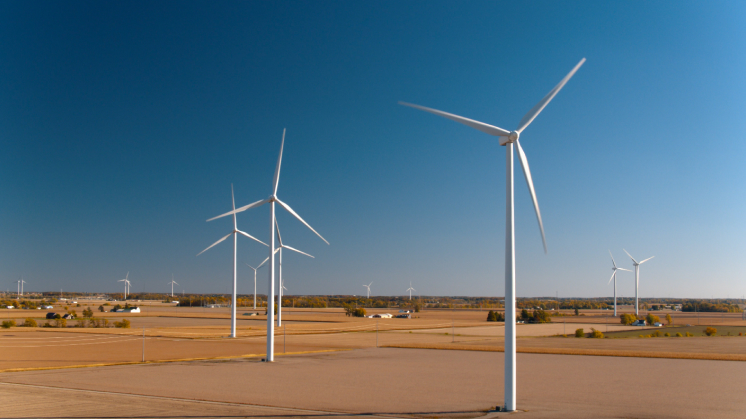
I noticed something strange last august driving through northwestern Ohio; wind turbines–a lot of them. It turns out I was within the confines of the largest wind farm in Ohio, the Blue Creek wind farm. This led me to wonder about the current state of wind power in Ohio. It turns out, it’s much different than when the Blue Creek wind farm was constructed.
The majority of the 152 turbines in the Blue Creek wind farm were constructed in 2011, becoming the largest construction project in Ohio that year. It became active in 2012, and today can power 76,000 homes per year. The wind farm coexists with local farmers by paying them to lease land for the turbines. The owner of the wind farm, Iberdrola, is the largest tax contributor to Van Wert county, where the majority of the turbines are located. The Blue Creek wind farm is adjacent to other notable wind farms such as the Timber Road wind farms, both of which take advantage of northwestern Ohio’s strong winds. Today however, neither would be possible to construct due to new regulations.
When these wind farms were constructed, regulations were loose, and optimism surrounding renewable energy in Ohio was at a high point. This is because in 2008, bipartisan legislation set a goal for 25% of Ohio’s energy to be renewable by 2025. This legislation, combined with the ongoing great recession, meant that wind projects were both a great way to invest in Ohio’s energy future and create jobs. Outside of wind, Ohio became the nations second largest manufacturer of solar panels 2010, further highlighting the overall optimism surrounding renewable energy at the time.
But things changed in 2014 when new setback requirements were adopted, ones that would render new wind projects in Ohio very difficult to construct. Prior to 2014, the minimum distance a wind turbine could be constructed from a property line just barely taller than the turbine itself. After the 2014 change, this distance was tripled to become 1,125 feet, a distance that only a dozen of the Blue Creek wind farm’s 152 turbines would be able to satisfy. On top of this, in 2019, the goal of achieving 25% renewable energy by 2025 was reduced to be just 8.5% by 2026. In 2021, individual counties were given the power to veto wind projects, something they can not do when it comes to new fossil-fuel projects. And most recently, in 2023 and 2024, natural gas and nuclear power were reclassified as renewable energy sources.
Progress in wind has still been able to continue though, albeit in a much more stagnant fashion. This is in part because some wind farms approved prior to the 2014 law. An example of this is the Hog Creek wind farm in Hardin County, which was approved in 2010, but only became operational in 2017. Until Ohio adopts less harsh setback laws and a stronger focus on green energy as a whole, Ohio will be continued to outpaced by its neighbors when it comes to the construction of new wind projects.